

Recovery
Recovery.
With the context included.
Stride places available HRV and resting heart rate readings alongside your personal history and sleep context. The estimate comes with the information needed to understand it.
See availability
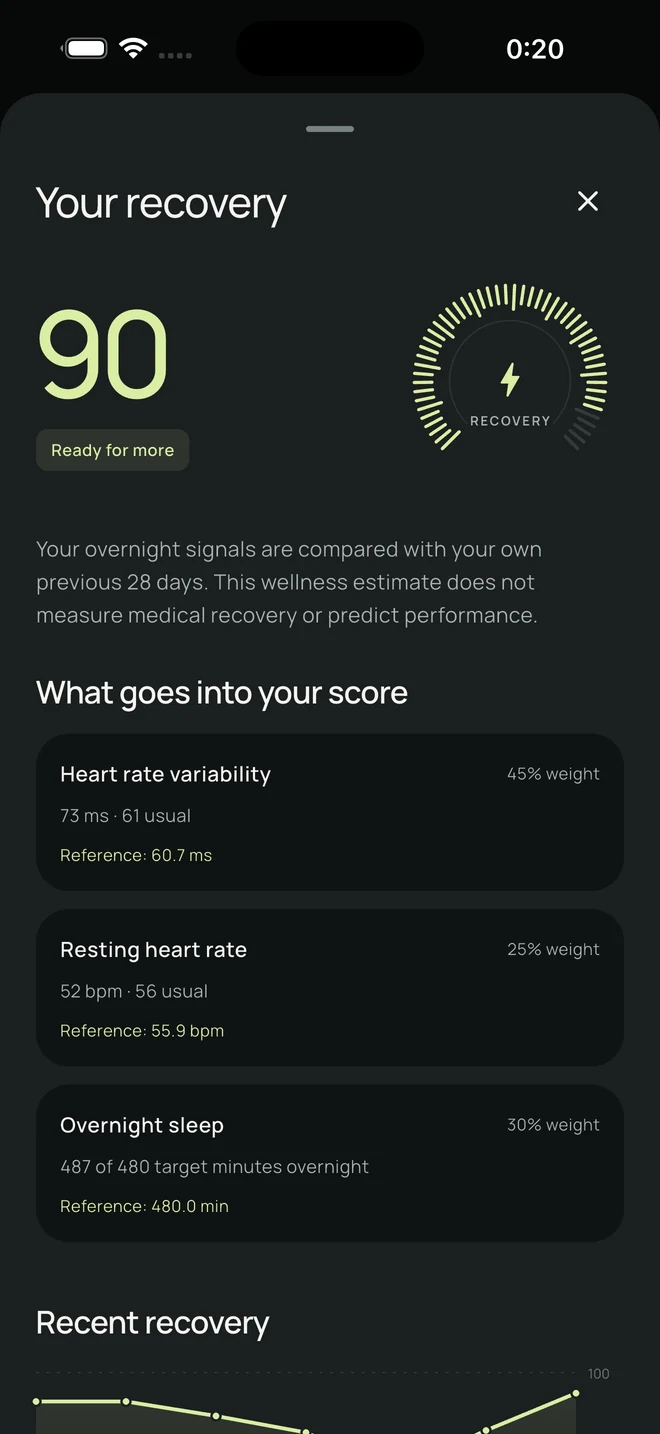
Your history is the reference.
Understand Stride recovery estimates through personal HRV and resting heart rate baselines, visible inputs and data coverage. Available with Stride PRO.
A baseline built around you.
Your baseline uses prior observations from the selected source. At least seven observations are needed before a baseline is available. A new connection or a source change may need time to establish a usable reference.
The point is to compare like with like. A reading from a different device or measurement method should not be treated as though it were simply another point on the same scale.
Read the explanation with the score.
Look at the contributing inputs and their coverage. Check whether current readings are available and how much history supports the reference. A prominent number does not remove uncertainty.
If the underlying records are incomplete, the estimate may be missing or carry lower confidence. Missing data is not a recovery score of zero.
Use it as context for your day.
Put the estimate alongside your sleep, recent activity and how you feel. Your plans and experience provide information a wearable cannot see.
Stride is not a training clearance tool. A favorable score does not override illness, pain, fatigue or your own judgment, and a low estimate is not a diagnosis.
Keep source differences visible.
Stride’s current Apple Health integration reads HRV as SDNN. Fitbit HRV through Google Health commonly uses RMSSD. These metrics describe variability differently and their baselines stay separate.
Today and Trends follow one selected source at a time. Stride does not combine Apple and Google totals into a single recovery history.
Your next chapter.
At your own pace.
Stride is on its way to iOS and Android.
Public downloads are not available yet.